First time on the lift
Taking a lift for the first time can feel a little nerve-racking. That applies to both children and adults, whether you’re skiing or snowboarding. But you usually get the hang of it quickly. Once you’ve tried it a few times, it often feels much easier than you first thought.

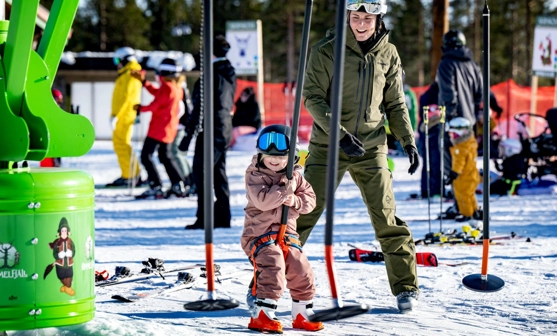
At Idre Himmelfjäll, there are good opportunities to start off slowly. In the children's area there are magic carpets and a lift carousel. The magic carpet helps children up a short hill, while the lift carousel is a rotating practice lift where children can get used to the feeling of a button lift in peace and quiet.
The most important thing is that you do not feel like you have to know everything right away. Watch how others do it, take it easy, and ask for help if you need it. It is completely normal to feel uncertain at first.
Some simple basic tips
Before we go through the different lifts, there are a few things that almost always help:
keep a calm distance to the person in front
look forward rather than down at your skis or board
don’t rush when getting on
listen to lift attendants and signs
say something if you feel unsure
For snowboarders, it is good to remember that one foot is usually free when riding the lift. That makes balance feel different than on skis, especially at the beginning.
Conveyor Belt
The conveyor belt is the easiest way to start. You step onto the belt and let it take you uphill while you stand still. It is especially suitable for small children, but also for adults who want to get used to the equipment at a calm pace.
In the children's area at Idre Himmelfjäll, the conveyor belt is a good first start. Here, children can try going uphill without first having to handle the pull of a lift.
In the same area there is also the lift carousel. It is not a lift you use to get up the slope, but a rotating practice lift where children can train on the feeling of a button lift in the same place.
It helps to keep this in mind:
• stand still and upright on the belt
• keep a little distance from the person in front of you
• step off calmly when you reach the top
• move to the side immediately after getting off

Chairlift
The chairlift is often easier than many people think. You glide to the loading point, wait for the chair, and sit down when it comes behind you. Then you sit calmly until it’s time to get off.
If you are skiing, it’s good to keep your skis pointing straight ahead. If you are snowboarding, you should keep the board steady and let it follow along.
Some simple tips on the chairlift:
• follow the markings to the loading point
• look quickly back when the chair approaches
• sit down calmly and immediately
• sit still during the ride
• get ready in good time before unloading
When you are getting off, stand up calmly and glide straight ahead. Try not to stop right where you exit. Keep going for a bit and then move to the side.

Chairlift with Small Children
For small children, a chairlift often feels safer than a drag lift, especially if the child is riding with an adult. The most important thing is that the child knows what will happen.
It can help to explain before you ride:
that the chair comes from behind
that you sit down right away
that you stay seated until you reach the top
that you stand up only when it is time to get off
It also usually helps to keep the conversation simple and calm. Children often feel safer when instructions are short and clear.
If the child is tired, cold, or worried, it is better to wait a little than to rush into a try.

Button Lift
A button lift is a lift where you get a round button behind you that pulls you up the slope. You do not sit on it, but stay on your skis or snowboard while the lift pulls you forward.
For skiers, a button lift is usually fairly easy to understand once you try it. For snowboarding, it can feel a bit more difficult at first, because the balance is different with one foot free.
Here’s what usually helps:
receive the button calmly
stand upright and relaxed
let the lift pull you instead of fighting it
make small adjustments if you need to
step clearly to the side when you let go
If you lose your balance, it is better to let go and move to the side than to try to save everything in the middle of the track.
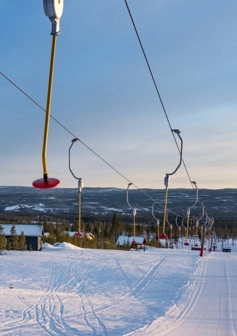
Button lift with small children
To practice riding a button lift, the lift carousel can be a good start. There, the child gets used to the pull and movement of a button lift at a calm pace, without also having to make their way up the slope.
When the child then tries a real button lift, it is a good idea to choose a calm and easy slope. The first time, it may be enough for the child just to feel how the lift pulls and how it feels to follow along partway up.
Everything does not have to work perfectly right away. For many children, it feels easier after just a few tries.
Anchor lift
An anchor lift requires a little more balance than a chairlift and a conveyor lift, but once you understand the feeling, it usually goes well. You stay on your skis or snowboard all the way up while the lift pulls you forward.
If two people are going up together, it is important to stay calm and let the lift do the work. Try not to pull on each other or steer too much.
Good things to keep in mind:
stand steadily from the start
keep your eyes forward
let the lift pull at a steady pace
try to keep your body relaxed
step aside right away when you arrive
For snowboarders, the anchor lift is often the lift that feels most unfamiliar at first. That is completely normal. It usually becomes much easier after just a few tries.
Anchor lift with small children
An anchor lift is often the most demanding type of lift, especially for small children, because it requires more balance and timing than, for example, a conveyor lift or chairlift. That is why it’s good to take it slowly, choose an easy lift, and expect that it may take a few tries before it feels right.
When a small child rides an anchor lift together with an adult, it becomes a little more difficult because they are different heights. To give the child good support, the bar needs to end up under the child’s bottom. In that case, the adult often has to adapt and keep the bar lower, against the backs of the thighs or in the knees. It is an advantage if the adult feels confident on the anchor lift themselves. Steeper sections can become more demanding when balance is already a little different, so the first try is often easier in a short and calm lift.
This usually helps:
choose a short and calm lift
adjust the bar to the child’s height
explain in advance how the child should stand
take it slowly at the start
stop if it doesn’t feel right
focus on safety before performance
There is no rush. For many children, it is better to take one step at a time than to try to manage everything on the same day.

For snowboarders
The lift can be a bigger challenge than the riding itself at first when you have a snowboard. This is mostly because one foot is loose and your balance is therefore different.
It usually helps to:
practice gliding with one foot on flat ground
keep the free foot close to the board
look where you’re going
start with a moving carpet or chairlift if you have the opportunity
It may feel unfamiliar at first, but it usually passes quite quickly.
When the child can't ride the lift alone
With very small children, riding the lift is mostly about calm, security, and timing. Choose the easiest way up and start where the child feels most relaxed.
At Idre Himmelfjäll, the children's area is a good place to start. There you'll find both a conveyor belt and a lift carousel. The conveyor belt helps the child up a short hill, while the lift carousel lets the child practice the motion in a button lift in the same place.
It helps a lot to:
explain in advance what is going to happen
keep the same calm routine each time
not try anything new when the child is already tired
praise the effort, not just the result
Sometimes it is enough just to try a little on the first day. That is also a good start.
It doesn't have to look perfect
Most people feel a little uncertain the first time on the lift. That goes for children, adults, skiers, and snowboarders. The important thing is not that it looks natural right away. The important thing is that it feels a little easier every time.
At Idre Himmelfjäll, there are good opportunities to start gently and take the next step when it feels right. That makes it easier to build confidence at your own pace.